ByJohn A
How to Evaluate Foam Suppliers for Consistent Product Quality
Introduction
Choosing a reliable foam supplier is an important decision for businesses that depend on protective packaging, insulation, cushioning, or lightweight components. The quality of the selected material can influence product durability, manufacturing efficiency, customer satisfaction, and long-term operating costs. For this reason, purchasing teams need to evaluate more than the quoted price when comparing potential suppliers.
Irradiated cross-linked polyethylene foam is used in several industries because it can provide a combination of low weight, cushioning, moisture resistance, and useful thermal insulation. However, its performance varies according to density, thickness, cellular structure, formulation, and manufacturing controls. These differences make supplier evaluation particularly important for companies purchasing foam in large quantities or using it in technical applications.
Working with an experienced IXPE foam manufacturer can help businesses identify suitable material specifications and maintain consistency across production orders. Understanding the manufacturing process, quality requirements, customization options, and service expectations makes it easier to establish a productive long-term supply relationship.
Understanding IXPE Foam Manufacturing
IXPE stands for irradiated cross-linked polyethylene. The material begins with a polyethylene-based formulation that is processed into a foam structure. Irradiation is then used to create cross-links within the polymer, helping modify its mechanical and thermal behavior.
The precise manufacturing sequence can vary by producer and product design. Formulation, foaming conditions, irradiation parameters, and subsequent processing all influence the properties of the finished material.
Foam may be supplied in rolls, sheets, blocks, or converted components. Depending on the production capabilities available, additional processes may include cutting, laminating, adhesive application, embossing, and custom fabrication.
Because each application has different performance requirements, manufacturers need to control both the base material and the final dimensions. A product intended for protective packaging may require different cushioning properties from foam used in an automotive interior or building insulation assembly.
Why Material Consistency Matters
Maintaining Dimensional Accuracy
Many industrial products require foam components to fit within a specific space. Variations in thickness, width, or cutting accuracy can create assembly difficulties and increase production waste.
For example, foam inserts designed to hold electronic components must fit securely without placing excessive pressure on delicate parts. Similarly, insulation layers may need consistent dimensions to support proper installation.
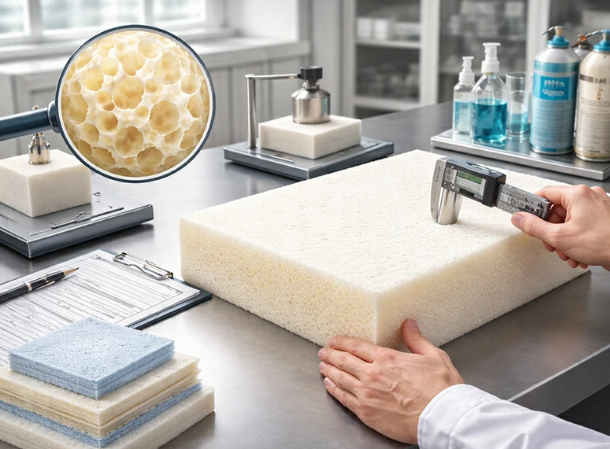
Purchasing teams should define acceptable tolerances before ordering. They should also confirm how dimensional checks are performed and whether the supplier can maintain the required specifications across repeated batches.
Achieving Predictable Cushioning
Foam is frequently selected for its ability to absorb impact or provide a protective barrier. However, cushioning performance depends on several variables, including density, thickness, compression behavior, and the force applied during use.
Two materials that appear similar may perform differently under repeated loading. If a product must protect fragile equipment or maintain comfort over an extended period, practical testing is essential.
A suitable supplier should be able to provide relevant technical information and discuss how material selection affects the intended application.
Supporting Stable Production
Manufacturing operations benefit from predictable raw materials. When incoming foam varies significantly between batches, production teams may need to adjust cutting settings, change assembly methods, or reject unsuitable components.
Consistent material specifications help reduce these interruptions. Businesses should establish documented requirements and maintain a process for reviewing incoming materials before they enter production.
Key Factors to Consider When Selecting a Supplier
Technical Knowledge and Material Selection
A supplier should understand the differences between foam grades and how those differences affect performance. Buyers should explain the intended application, expected loads, environmental conditions, and any relevant regulatory requirements.
The supplier can then help identify suitable options for evaluation. However, final approval should be based on documented specifications and testing rather than general product descriptions alone.
For demanding applications, technical discussions should cover compression behavior, dimensional stability, temperature limits, moisture resistance, and other properties relevant to the finished product.
Quality Control Procedures
Quality control helps ensure that products remain within agreed specifications. Buyers should ask how the supplier monitors density, thickness, appearance, and other critical characteristics during production.
The required checks depend on the application. Some products may need only basic dimensional inspection, while others require additional testing for thermal performance, mechanical behavior, or compliance with industry standards.
Businesses should also clarify how nonconforming products are identified and handled. Clear procedures make it easier to address quality concerns and reduce the risk of defective materials reaching customers.
Production Capacity and Lead Times
A supplier’s ability to meet delivery schedules is essential for manufacturers operating on fixed production plans. Delays in foam supply can interrupt assembly, packaging, or construction activities.
Purchasing teams should confirm normal lead times, minimum order quantities, production capacity, and the process for handling urgent orders. They should also discuss how the supplier manages demand fluctuations and repeat orders.
It is useful to distinguish between the production time for standard products and the additional time needed for customized specifications. Clear expectations reduce misunderstandings and support more accurate inventory planning.
Customization and Conversion Services
Many businesses require foam in specific shapes, dimensions, or combinations with other materials. Customization can include die-cutting, slitting, lamination, adhesive backing, and surface treatments.
A supplier offering suitable conversion services may help reduce the number of processing steps required at the buyer’s facility. This can simplify production planning and improve component consistency.
Before approving a custom design, businesses should evaluate samples and confirm that the selected process can achieve the required tolerances. Any changes to the design or material specification should be documented.
Communication and After-Sales Support
Good communication is particularly important when orders involve custom dimensions, technical specifications, or multiple production stages.
Suppliers should provide clear quotations, product documentation, delivery information, and responses to technical questions. Businesses should also establish whom to contact when a material fails inspection or an order does not meet the agreed requirements.
Reliable support can make problem-solving more efficient and help both parties improve future orders.
Applications That Require Careful Foam Selection
Automotive Components
Automotive applications may use foam for interior cushioning, insulation, vibration management, and protective layers. Material selection must account for temperature variation, repeated mechanical stress, and the requirements of the surrounding assembly.
Depending on the application, buyers may also need to evaluate odor, emissions, flame behavior, and durability. Supplier documentation should be reviewed against the vehicle manufacturer’s specifications before production approval.
Protective Packaging
Packaging designers use foam to protect products from movement, impact, and vibration during transportation. Electronics, instruments, machinery components, and fragile goods may require custom-cut inserts.
The ideal foam grade depends on product weight, fragility, shipping conditions, and the required level of protection. Prototype testing can help identify an effective design while limiting unnecessary packaging material.
Building and Insulation Products
Foam can contribute to insulation, cushioning, and protective functions in selected construction applications. However, performance requirements vary according to the building system and local regulations.
Purchasers should confirm temperature limits, moisture-related requirements, dimensional stability, and applicable fire-safety standards. Installation methods should also be considered because gaps and excessive compression can reduce overall system performance.
Consumer Products
Foam may be used in exercise products, protective accessories, footwear components, and other consumer goods. In these applications, comfort, surface quality, flexibility, and long-term shape retention can influence customer satisfaction.
Testing should reflect how the product will be handled, cleaned, stored, and used. A material that performs adequately during initial inspection may still require further evaluation if it experiences repeated compression or environmental exposure.
Managing Costs Without Compromising Quality
Price comparisons are useful, but the lowest quotation does not necessarily represent the best overall value. A lower-cost material may create more waste, require additional processing, or fail to meet the required service life.
Businesses should compare suppliers using a consistent specification. This means evaluating equivalent material grades, dimensions, tolerances, packaging requirements, and delivery terms.
The total cost of ownership may include the purchase price, transportation, inspection, cutting losses, assembly labor, storage, and replacement of defective components. For custom products, tooling and setup costs may also influence the economics of an order.
Forecasting demand and consolidating compatible orders can sometimes improve purchasing efficiency. Nevertheless, inventory decisions should balance potential savings against storage costs, material protection, and the risk of holding products that no longer match updated specifications.
Sustainability and Responsible Procurement
Environmental considerations are becoming increasingly relevant to material purchasing decisions. Businesses can begin by assessing how efficiently foam is used during manufacturing and how much waste is generated during cutting and conversion.
Better component layouts, accurate dimensions, and suitable material thicknesses may reduce avoidable scrap. Suppliers can also be asked about manufacturing waste management and available material recovery options.
IXPE is a cross-linked polymer, so its end-of-life treatment may differ from that of conventional recyclable thermoplastics. Buyers should not assume that every product can enter a standard polyethylene recycling stream. Available recovery methods depend on the material construction and local facilities.
A responsible procurement approach considers durability, manufacturing efficiency, packaging, transportation, and end-of-life options together.
Frequently Asked Questions
1. What information should buyers provide when requesting an IXPE foam quotation?
Buyers should specify the intended application, required thickness, density or hardness where applicable, dimensions, quantity, surface finish, customization needs, and delivery requirements. Environmental conditions and relevant performance standards should also be included when they affect material selection.
2. How can businesses verify the quality of an IXPE foam product?
They can review technical data sheets, inspect samples, confirm dimensional tolerances, and request relevant test reports. For critical applications, testing should reproduce the expected operating conditions. Documented acceptance criteria help ensure that future orders meet the same requirements.
3. Is customization available for IXPE foam products?
Customization may include cutting, slitting, lamination, adhesive backing, and other conversion processes, depending on the supplier’s capabilities. Buyers should confirm available options, minimum order quantities, tolerances, and setup requirements before placing a production order.
See also: Top Fantastic Travel Attractions in Bangkok
Conclusion
Selecting a suitable foam supplier requires a careful assessment of material properties, quality control, production capacity, customization options, communication, and long-term cost. These factors influence whether a product will meet its intended performance requirements consistently.
Businesses should begin with a clear specification, evaluate samples, and confirm technical information before committing to larger orders. Establishing documented quality standards and reviewing supplier performance over time can help prevent avoidable production problems.
With a structured procurement process and a dependable supply relationship, manufacturers can improve material consistency, reduce waste, and support more efficient production across a wide range of applications.